Friday, December 25, 2009

Avatar's Bigger Picture


I actually just walked in the door from seeing the incredible new movie Avatar. (The James Cameron film, not the whole "last airbender" thing). I won't deny that throughout the entire movie, I thought of maybe three or four blog posts I could write about it, one part (or one line, rather) really stuck out to me.

In a scene near the climactic battle sequence of the film, the primary antagonist, Chief of Security Colonel Miles Quaritch, outlines his battle strategy to his military followers; "Our only security lies in preventative attack," he says, "we will fight terror with terror."

Immediately after hearing this line in the film, I gained a new hatred for Colonel Quaritch (not that I didn't hate him enough before it...) Call me emotionally attached to this film, but the Na'vi race could under no circumstances be considered terrorists. Their home was being invaded, their innocent people killed and their resources exploited...wait, sound familiar?

Hearing the Na'vi people's displays of rebellion described as "terror" made me think of the broad connotation of the word "terror" in the current war we're fighting on it. If the innocent Na'vi could be considered terrorists, anyone dissenting against the government could. I know we've moved out of our Perilous Times unit, but I personally thought that this movie touched on a lot of the themes we covered in our War on Terror Presentation.

Friday, December 11, 2009

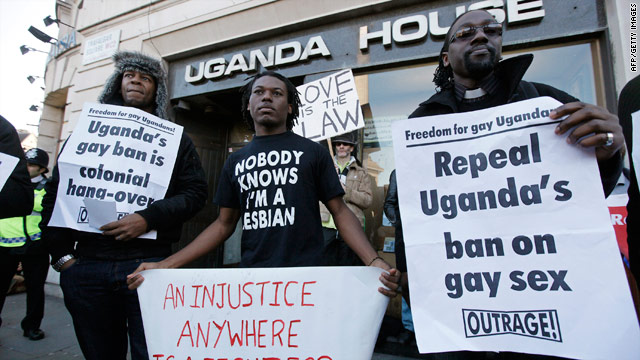
Gay Genocide?

Two years ago, I did a pretty huge project for world history about Ugandan genocide and child soldiers. I researched the conflicts, the victims, and the foundations working to stop it. The genocide taking over Uganda is a violent conflict between the Lords Resistance Army (LRA), a guerilla group spearheaded by a man named Joseph Kony, and the Ugandan government under President Yoweri Museveni. The LRA has been known for their inhumane warfare tactics, including the use of trained child soldiers.

It seems today, however, that there is a new kind of genocide arising in Uganda. Very recently, President Museveni has issued pending bills that actually criminalize being gay. Ugandan gays and lesbians accused of partaking in gay sex can be sentenced to such extremes as a life sentence or even the death penalty. Those who test positive for HIV can also be executed. As one Ugandan women named Elizabeth Mataka pointed out, "Who will go to HIV testing if he knows he will suffer the death sentence?" For the HIV positive, choices end only with death.

We think that California's Proposition 8 is so unjust, think about this. In a world that most of us like to deem progressive, how can civil rights be so greatly limited, especially in a nation in war against "inhumane" guerillas in the first place? Do the perilous times in this genocide-stricken country call for these drastic measures?


Tuesday, December 8, 2009

56%??

While browsing around CNN's website for a blog topic, I noticed a little poll in the bottom corner of the screen; "Do you believe global warming is a proven fact caused by man?" I quickly voted 'yes' and viewed the voting tally. I didn't expect it to be 100%, of course, but the results shocked me. Only 56% voted 'yes,' while the remaining 44% didn't believe that global warming exists. I don't mean to sound conceited because I don't know what these people's reasonings were behind voting the way they did, but it seems like a lot of people are pretty ignorant about the incredible issue of global warming.

Even after Al Gore's "An Inconvenient Truth" shocked Americans three years ago, and the mass confusion and anger set in about the causes and effects of global warming, only 56% of our country believes it's even a manmade problem. It has been said that "global warming is no longer a political issue but rather, the biggest moral challenge facing our civilization today" (ClimateCrisis.net). Americans need to take notice of what's going on our planet, and try to mobilize to stop it.

One step that has been taken that I find really great is the Copenhagen Climate Conference, taking place right now in Copenhagen, Denmark. (Our own President Obama is scheduled to attend next week). However, just this week has America's Environmental Protection Agency formally released a statement declaring that greenhouse gases are harmful to human health. This has raised hopes nation-wide that President Obama will harness the ability he has to put laws in order to limit the amount of carbon emissions we put out. While many republicans and even some democrats believe that cutting out great quantities of carbon emissions will be very bad for the nation's industry, President Obama has thankfully placed it high on his list of priorities.

All of this seems to raise the question; what is more important in American right now- the economy, or the climate crisis? It seems to be a win-lose situation either way, but it's time for us to stop thinking selfishly and embrace our power as a world leader to help the world as a whole. Solving the climate crisis will not only help our nation prosper ultimately by allowing ourselves and our children to live on a safe planet, but we will also be helping nations worldwide.
This isn't only about us- I can't believe that in the most powerful nation in the world, we can't take enough initiative to help the planet we lead. When only 56% of the nation is willing to accept the existence problem, how can we expect a solution to be reached? Hopefully President Obama will make some good decisions at the Copenhagen conference, and I'll be a little bit more proud to call myself an American.

Saturday, December 5, 2009

Freedom of Speech Motherf***er!!


Yes, that is the first line of Immortal Technique's song "Freedom of Speech" (you have no idea how much I wanted to use it for our Perilous Animoto...it ended up being a little bit too explicit for the group's taste though.)

Anyway, take a listen to the song. It's pretty good! I love it. After downloading the song (thanks to Sarah Goomar), I went on to research the rapper Immortal Technique a little bit more. I already had a song by him ("Dance with the Devil"- it's pretty scary but also an amazing song, I'd recommend a listen if you've never heard it), but I never really knew who Immortal Technique was. From his wikipedia article, I learned that the rapper's real name is Felipe Andres Coronel, he is 31 years old, he was born in Lima, Peru, and he is not, nor has he ever been signed to a record label.

That last part is the part that really shocked me- how is it possible that an artist as truly talented as Immortal Technique (by my standards) isn't signed when all of those crappy rappers out there like Asher Roth are??

And then it occurred to me- the whole point of the song "Freedom of Speech" was that being signed to a label was a limit of the first amendment in itself. Immortal Technique doesn't want to be signed to a label because what he raps about is important to him- he doesn't want corporate sponsors and record label executives telling him how to express himself and when to tone down his message.

I never really thought of having corporate sponsors as a limit of freedom of speech, but I guess that's the compromise many artists will make for fame and the ability to have their music heard. In what other ways is freedom of speech limited by mainstreamed American culture?

(Another thing to ponder is what effect Immortal Technique's country of birth may have had on his political views- having not been born in the United States, how could his outlook be different than those of us who are American-born citizens?)

Monday, November 30, 2009

Is the War on Terrorism Turning into the War on Islam?

After reading Mr. Bolos's latest blog, I found myself with a lot of leftover thoughts. To many thoughts, in fact, for a simple comment. My thoughts are pretty all over the place, so I'm sorry if this post is a little random. However, the blog mostly reminded me a lot of a case I was reading about when researching The 2001 USA Patriot Act as a part of my Perilous Project.

It is the story of a man named Albader Al-Hazmi.

Al-Hazmi's name is significant because it is very similar to the names of two of the suicide hijackers known to be involved in the attacks on 9/11. Shortly after 9/11, when Al-Hazmi (our innocent radiologist from San Antonio, Texas) tried to book a flight to San Diego for a medical conference, he was arrested as a "material witness." He was held incommunicado for six days before his lawyers were able to access him, and was not ultimately released for a few more days after that.

After his release, Al-Hazmi's lawyer said "This is a good lesson about how frail our processes are. It's how we treat people in difficult times like these that is the true test of democracy and civil liberties that we brag so much about throughout the world" (Feinstein 2001).

Without a doubt, this story shows some existence of bias against Muslim Americans, mostly following the 9/11 attacks. Are "random security checks" at airports really random? I believe "The Narrative," and I know that if I was an active Muslim living in America, I would feel that my religion was being threatened by the War on Terrorism. Just like with the Japanese in WWII, the American people are blaming a large group of people for the actions of a select group. In my opinion, we all need to get more educated about the war we're fighting, and unite with the primarily peaceful Muslim community to stop the bias and the hate. But how can we do this? What do you think America is doing wrong in terms of educating the public on the War on Terrorism and our enemies? How can it be fixed?

Monday, November 16, 2009

My Father, the Nazi.


Barbara Cherish has had to deal with the aftermath of her father's occupation her whole life. It has become her identity, she has been judged for it, and punished for it. Her father, Arthur Liebehenschel, was the Kommandant of Camp I in the Auschwitz Concentration Camp during World War II. As I was reading an article I discovered on the subject, I found myself sympathizing incredibly with Cherish. Her father was executed following the end of the war, and her mother later committed suicide in a mental institution, leaving her in foster care since age six. She never even had the chance to build a relationship with her parents, and yet she faces the consequences and feels the guilt of their actions every day. In her book, "The Auschwitz Kommandant: A Daughter's Search for the Father She Never Knew," Cherish addresses her situation, and what kind of emotions it has left her with. She speaks about the good reputation that her father had with the prisoners at Auschwitz, and why she believed he did the things that he did.

Reading this article made me wonder a lot about family guilt. If a person is guilty of a crime, what consequences should fall on the person's family? Think about a child getting in trouble at school- should the child's parents be blamed? In my opinion, they should (in part) be at fault. The distinction becomes much more complicated as people age, however. Of course, Barbara Cherish should not have been blamed for her father's actions; she was only a small child when the war was even taking place. But how should a family take responsibility for the actions of their kin?

In "The Crucible," Arthur Miller writes in the "Echoes Down The Corridor" that "Twenty years after the last execution, the government awarded compensation to the victims still living, and to the families of the dead" (135). Did the families of the wrongly-accused witches deserve compensation for their ancestor's executions? Does Barbara Cherish deserve compensation for her father's execution?

Monday, November 9, 2009

Lost and FOUND

Last Thursday, I went to LitFest. It was incredible. I loved every guest, I never took my eyes off the stage. The performances had me enticed from beginning to end. I'd have to say that my favorites were either Reggie Gibson (the poet/writer who visited us in class) or The Handsome Family. Butt, there was one guest who I found particularly...interesting. Davy Rothbart, of FOUND Magazine.

Found Magazine is a magazine created and edited by Rothbart, showcasing written items and photos that he, his team, and even random strangers have found. While this is a very interesting idea, and many of the "found" items were hilarious, one thought stuck in my head throughout the whole presentation. That would suck so bad if one of those was mine. Of course the magazine is mostly a joke, but Rothbart also read some pieces that were pretty sentimental (i.e. a son's letter to his deceased mother, found in a graveyard tied to a balloon).

Do these people know that their seemingly private notes are being published for the world to see? It reminded me a lot of our class discussions about the right to privacy. I personally don't believe that everybody has the right to see these things. And while I'll admit that I bought a FOUND Magazine, I felt pretty bad about it afterwards. I know I wouldn't want my letters, diary entries, or pictures published- why would I want to see other peoples'? What right does this magazine have to publish things like that? I work in a medical office, I file paperwork every day, and I know how private those things are and how secretive I have to be about even the names of the patients that I see. What if it was a "found" medical record? Where do they draw the line?

I noticed on the website, on the list of "contacts," that there was a man with the job description of "ethicist." At least FOUND Magazine realizes that there is an ethical controversy behind what they're doing, but I wonder what that guy's job really is. Maybe I'll email him.

Monday, October 26, 2009

Women at Arms: Does Sexism Still Prevail?


Just about five minutes ago, I discovered a really interesting video on www.nytimes.com about women in the military. Fighting in Iraq and Afghanistan, these women are exposed to almost all of the same dangers that men are. Almost.

Check it out! (the website won't let me embed it so you'll just have to click on the link...grrr.)

The video addresses the rules against women's participation in ground combat situations. The news correspondent interviewed a couple of women serving in the military who live under this restriction, and their responses shocked me. Some seemed upset with the seemingly sexist rule, and others supported it by acknowledging the weaknesses of male peers when it comes to women captives.

Personally, if I were a woman in the United States military, I would be outraged at any kind of restriction based on gender. That is not what our country is about, and it's unconstitutional. Having just recently talked about the Constitution in class, I was left asking, What happened to equal rights? Equal opportunities? I'm aware of the dangers surrounding it, but I don't understand how a generalization could be made about an entire gender with no experience to base it off of. Is restricting women from certain military positions unconstitutional or intelligent?

Thursday, October 22, 2009

Do You Need a Personal Assistant?

Surfing the web today, I came across an article that I found laughable, but at the same time pretty concerning. The article was about Charley Cooper, a sophomore boy at Georgetown University, and his need for a personal assistant.
Personally, when I think of people that might need personal assistants, I think of movie stars, huge business managers, and CEOs. I never once thought of a student needing one. (Unless it was a joke in a kids' movie or something- you know the ones with the bully and his follower minions? I guess those are kind of like personal assistants...) Anyway, this Charley Cooper kid set up an ad on his university's employment website, advertising his need for a personal assistant to do "some of [his] everyday tasks." These included picking him up and dropping him off at class, putting gas in and providing maintenance for his car, doing his laundry, and scheduling appointments.
Upon reading this, I immediately judged Charley Cooper as an obnoxious rich kid who doesn't want to have to do his own work. But after reading about his background, class load, part-time job and the illness that he's dealing with in his family, I realized that there probably are many students out there who need a personal assistant.
I know from experience that high school (especially here at New Trier) can be an unbelievably competitive and stressful experience. While it can be fun, there are some times when I just want to forget about all of my classes, say "f*** it" to my homework, and go home to get some actual sleep. I'm sure all of you have felt the same way. You're in a four-level class, it's bound to happen. And it's probably even worse at college!
Now think about how much easier your life would be if there was someone there to take care of all of your insignificant tasks; to drive you places, pick up things when you needed them, help you manage your time and your schedules. I would LOVE that. Thinking about this in depth, I have gained a new respect for Charley Cooper. He's not obnoxious, he actually has a really good idea.

Could school be structured in too stressful a way for us to get everything done on our own? Or does Charley Cooper just have too much on his plate? What do you think?

Saturday, October 10, 2009

Fighting


Fight Club wasn't about winning or losing. It wasn't about words.
-"Fight Club," 1999.

Before even having the class discussion (I swear that's not the only reason I wrote this post), I found myself very stricken by the fighting scene in Narrative of the Life of Frederick Douglass. Throughout my whole reading of the book, I admired Douglass for his intelligence, his representative story, and the fact that he never showed any anger towards anything other than the institution of slavery itself. He often even sympathized with slaveholders because he knew that it was slavery's effects on them that made them cruel; "At this very moment, I saw more clearly than ever the brutalizing effects of slavery upon both slave and slaveholder" (27). And it was this understanding of slavery that made Douglass's fight with Covey so shocking to me. I would never have thought of Douglass as the kind of person to solve his problems physically. He understood that it was not his slaveholders' faults, but rather the fault of the institution. In my opinion, this is why he decided to run away to the North in the first place. He could rebel against his slaveholders, but he would never be able to escape the Institution, unless he escaped to the North.
Now I have a lot of guy friends, and I know how obsessed they are with fighting. I didn't think I would EVER understand why, but every guy seems to understand exactly how to solve a problem- with a fight, of course. I have argued with them about it countless times. I told them that fighting doesn't solve anything; when they are all bloodied in the end, their problems would still be there. And they would never agree. "Guys can have a fist fight and shake hands in the end, knowing that the problem is over. Girls go behind each other's backs and gossip and never ever let the problem end," they'd say. And I would always argue back, "Not all guys have the need to fight; I'm sure there are some that can just be peaceful and solve their problems like humans...Like say, Frederick Douglass."
Reading that scene, to me, was like realizing that Santa Clause isn't real. Even Frederick Douglass, a man who I had looked at as so respectable and calm, who took countless thrashings and lived under the power of an institution as cruel as slavery without ever lifting a finger in rage towards an overseer, saw a positive end result in violence. I'll admit, this scene changed my views on fighting entirely. Maybe it does solve problems. It certainly solved the one between Douglass and Covey. This scene opened my mind, and made me see the positive effects that fighting can have on certain specific situations. I can't think of many others in which it would benefit, but I've taken a step in my stubbornness to admit that it worked here.

What do you think?? In what other situations do you think fighting can be helpful?

Monday, September 28, 2009

A Risky Consideration

Every student must remember last year's presidential election; walking through the halls of New Trier seeing all the hipsters rocking their Shepard Fairey Obama T-shirts, seeing political pins on students' backpacks, and witnessing the student election (which Obama happened to win by quite a large margin actually). It was clear from all of the excitement that Obama, without a shadow of a doubt, had the young people's vote in the bag. Everyone in America was at least somewhat interested by Obama's promise of change; it was the goal of his campaign altogether.

The thing that I find most interesting about Obama's youth-aimed campaign is how amazingly it actually worked. Obama managed to get more voters under 25 years old out on election day than ever before (http://www.time.com/time/politics/article/0,8599,1700525,00.html). Young people love Obama. It's a trend, and high school students love to follow it.

So, when I came across this article the other day, I couldn't help but ask Why, Obama? Why?

Obama is considering cutting short one of the few things that ALL teenagers, no matter what gender, race, clique, and age love. What could it be, you ask? Summer vacation.

No decisions have been made yet, but the fact that Obama has even announced that he's considering this is extremely risky. With such an incredible following of students, I would never guess that Obama would introduce something like this so early in his term.

While it is true that the school calendar, based on the agrarian calendar and farming months, is a little bit outdated, reading this article really made me think about what reactions would be like if it actually happened.

How would you all react if your summer vacation got cut short?

Sunday, September 13, 2009

Best Female Video Goes To...

So basically I'm watching the Video Music Awards on MTV right now (Green Day is performing..w00t!!), and something just happened that shocked me more than I can believe. The award for Best Female Video was announced, with nominees Taylor Swift, Katy Perry, Kelly Clarkson, Lady Gaga, P!nk, and Beyonce. (www.buzzworthy.mtv.com). The presenters came out, listed all of the six deserving women, and announced the winner....Taylor Swift.

She walked up to the stage, and shyly accepted her award. She went on to thank everyone for allowing her to have the award despite her background in country music, seeing as how the VMA's are a usually pop-dominated awards show. Now I'm not a huge Taylor Swift fan, but I'll admit that I think she's sweet and she's worked hard to get where she is today. She may not have deserved the award as much as...I don't know, Beyonce- but she deserved it nonetheless.

However slightly upset I was that Taylor Swift won the moonman, I was forced to defend her the second I witnessed what happened next.

Kanye West strutted on to the stage.

(Now we all know where this is going...)

He forcefully took the mic straight out of Taylor's hands, put it to his lips, and began to praise the woman he believed should have won the award. Check it out.


The poor girl didn't even know if that crowd was booing Kanye or if they were booing her. Nobody should have to go through that, especially when they're receiving an award for something that they've worked really hard towards. It should have been a beautiful moment for her, but it was ultimately ruined by Kanye's self-righteous need to let the world know his opinion. What did he expect? That they would just give Beyonce the award because he said so? Because she was his favorite? Even Beyonce looked horribly embarrassed by the whole situation.

To be honest, this post is kind of starting to remind me of my last one on Spencer and Heidi Pratt. Now don't get me wrong, I think that Kanye West has a hell of a lot more talent than Spencer and Heidi in every way, but his conceit is just as obnoxious as theirs. What makes him think that his opinion is so important? Does he not realize that being such a jerk undermines his talent so incredibly? I might actually be a Kanye fan if it weren't for his disgusting personality, and he doesn't seem to realize how much it affects his image. Grow up, Kanye. And apologize.

Friday, September 11, 2009

King Spencer Pratt?

I'll admit it, I read quite a few gossip magazines. From People to Us Weekly to OK! Magazine, I pretty much will always read the weekly celebrity gossip if I can get my hands on it. Although I will say that two people I cannot stand to read about, even if what's being said about them is horrible, are Spencer Pratt and Heidi Montag. They honestly give a new meaning to the word obnoxious.

At the beginning, I thought that their stunts and horribly posed tabloid pictures were some kind of elaborate joke to gain social status. In fact, I was sure that they were kidding. Nobody could be that delusional; maybe they were poking fun at how mindless American culture has become, maybe they had plans to turn themselves around and use their influence to do good things. I would have guessed anything, but never that they were actually serious.

Recently though, it seems that their behavior has gotten out of control. Most famously, the "I'm A Celebrity...Get Me Out of Here!" stunt, in which the couple complained that the show was "torturing" them and that only Jesus would save them. Upon quitting she show, Spencer Pratt made the statement, "The only way we got through it was praying. Jesus delivered us" (www.abcnews.go.com).

The thing that I found most shocking, though, has been Spencer Pratt's recent decision to change his name to "King Spencer Pratt." England has a queen, why shouldn't there be a King of America? And he has so righteously nominated himself for that position.

Ladies and Gentlemen, the King of America: Spencer Pratt.


Is that really how anybody would want to be represented? Of course, it's a complete joke and I highly doubt anybody will take his ridiculous delusions seriously, but the fact remains the same. Is this really what we want to see as the face of the United States?

Nobody is going to hail "Speidi" as the leaders of the nation, but at this point I am beginning to believe that they honestly think they are. It is no stunt, it is no elaborate plot; these people actually think they are that important. This joke has gone way too far, and it's an embarrassment to the entire nation now.

Thursday, September 3, 2009

More Reckless Means...More Mature?

I actually had a pretty hard time this week thinking of something to blog about- something that both caught my attention and related to my life. Wasting away attempting to read all of those boring, uninteresting articles on those boring, uninteresting news sites, finally something struck my attention. A headline reading "The Teen Brain: The More Mature, The More Reckless." Immediately I thought, This can't be true- I know kids that do reckless, dumb things; and there's no WAY that they're more mature than me. I continued to read the article. There was a lot of scientific stuff in it, talking about how the "gray matter" of the brain gradually decreases as teenagers get older and progress into adulthood, and how it is replaced with the more mature-thinking "white matter". Apparently, a person's brain doesn't fully finish developing until he or she is 25 years old (Time Magazine Website). Or at least that's when the minimum amount of gray matter is left in the brain. So really, adulthood doesn't truly come until the age of 25. I like to think that I'm pretty grown up now at the age of sixteen, but wow, 25? That's a stretch.

Anyway, the writers of this article studied a research paper conducted by psychiatrist Gregory Burns, in which they polled 91 students aged 12 to 18 and asked them what kinds of risky behavior they partake in on a regular basis. After the students completed the surveys, the researchers did brain scans on them, and the results were surprising to say the least. As it turns out, contrary to popular belief, the students that admitted to partaking in the most reckless activities were also the ones with the highest amounts of white matter in the brain.

Talk about a shocker.

The writers of the article went on to explain how teenagers that are too mature for their age tend to test their adult-like limits in order to find a comfortable living niche that accounts for their untimely maturity. This could easily be misunderstood as reckless behavior. I get that; there certainly is that select group of reckless, misunderstood kids that act out just because they want to know what they're capable of.. In my opinion, that is the group of kids that this article is referring to as recklessly mature. There is also that group of incredibly stupid teenagers that make impossibly unintelligent decisions just to fit in and get attention. In my opinion, that is the group of kids that wish this article was referring to them.

I'm still not so sure if I agree with everything this article says, but it certainly was an interesting read and I'm glad that a lot of "misunderstood," stereotypical teenage behavior is finally being brought into the light and understood. What I'm trying to say is, the next time your parents yell at you for doing something stupid, you've got a pretty good excuse.